
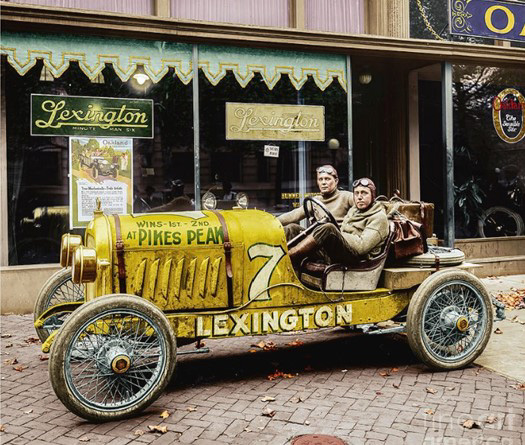
Will all those who have heard of the Lexington automobile please raise their hands. Hmm … I see but one. That’s the hand of VAE member Hamilton Hayes. There’s one in his family tree.
The Lexington Motor Company was established in 1909 in Lexington, Kentucky. That’s Kentucky, not Massachusetts, although the connection was not lost on the company. They remained there for only one year and then relocated a bit north to Connersville, Indiana. They exploited the fact that the company name was reminiscent of the Revolutionary War battle site in naming some models. They introduced a model designated the “Minute Man Six” and later a Concord model. For a while the company emblem featured a minuteman with a musket.
The Lexington Motor Company stayed and grew in Connersville. During its history, it underwent changes in ownership and affiliation. Early on, it was bought by E.W. Ansted, a manufacturer of springs and axles and ultimately the engines that powered the cars. The Lexington was an assembled car with components made by their affiliates, and one of its major features was the performance from the Ansted six-cylinder engine. By 1920, production peaked at a little over 6,000 cars. In that year, they proudly demonstrated their outstanding performance by taking the top two places in the Pikes Peak hill climb.

That’s where Hamilton’s family connection comes in. His uncle, John Hayes, was a bit of a “wheeler dealer” in used cars in the late ‘40s and somehow ended up in possession of the very car that took the first place in that famous hill climb. The accompanying photographs show the car immediately following its triumph in 1920 and then later after it had somehow found its way to Vermont.
From that 1920 production peak, Lexington’s fortunes diminished. The recession following the end of World War I took its toll on the automobile industry.
Lexington’s production dropped greatly and steadily over the following years to 183 by 1926. As a consequence of that decline, the company went into receivership in 1923. In spite of that grim circumstance, they won the Pikes Peak trophy again in 1924, but such glory is not business success and the company was purchased by Auburn Automobile Company in 1927. The Lexington was phased out while the facilities remained in use by Auburn.
Could it be that some of the Lexington’s automotive DNA found its way into subsequent Auburns and Cords? They are all part of history now.

Leave a Reply