
Last April, while volunteering at my lapidary club’s annual garage sale in Green Valley, Arizona, I was assigned to sort agates, crystals, and other stones of every shape and size. As I worked through more boxes than I could possibly finish, I found what looked like a chunk of colorful rock. I asked Laura McQuillen, who runs the club’s dichroic glass program and whose work I greatly admire, what exactly I was holding.
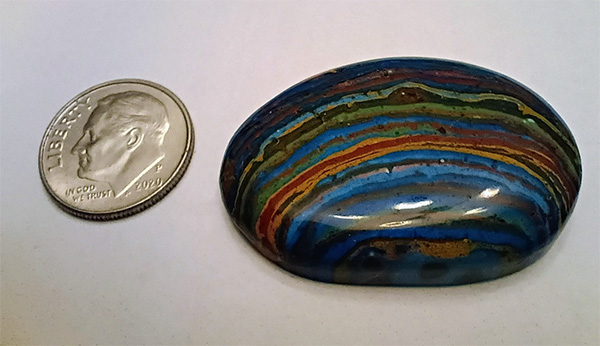
Laura explained that in the late 1970s, when she was 18 and working on a General Motors assembly line, employees could take temporary jobs during the summer shutdown. She joined about 60 coworkers cleaning paint booths, where cars received their glossy finishes. Using three- to four-inch chisels and mallets, they scraped and peeled away layers of paint that had built up over the previous year. The hardened paint fragments became known as Detroit Agate at GM and Fordite at Ford; other names included Motor City Agate and Cadilite, associated with Cadillac. Lapidarists eventually discovered that the material could be cut and polished into jewelry cabochons, which are now highly prized worldwide.
Laura recalled that GM produced about 20 pink “Pink Pearl” Cadillacs each year for Mary Kay Cosmetics’ top saleswomen across the country, and she described seeing that color pink emerge as they chipped away the paint as striking!
Whatever the name, these hardened paint layers captured the changing colors of the American auto industry.
Laura let me keep my “found” Detroit Agate; then she cut and polished it into the piece shown here. I may turn it into a keychain—or just keep it as a piece of automotive history. Alas, there’s no Pink Pearl in it.
Leave a Reply