

As long as automobiles have used electricity to power anything other than ignition, they have required a means of generating DC power to replenish the battery. In 1912, Cadillac introduced the first DC generator (dynamo) for this purpose. It served that function for nearly six decades. In 1960, Chrysler introduced the first alternator as an electrical power source which was quickly adopted by the entire industry.
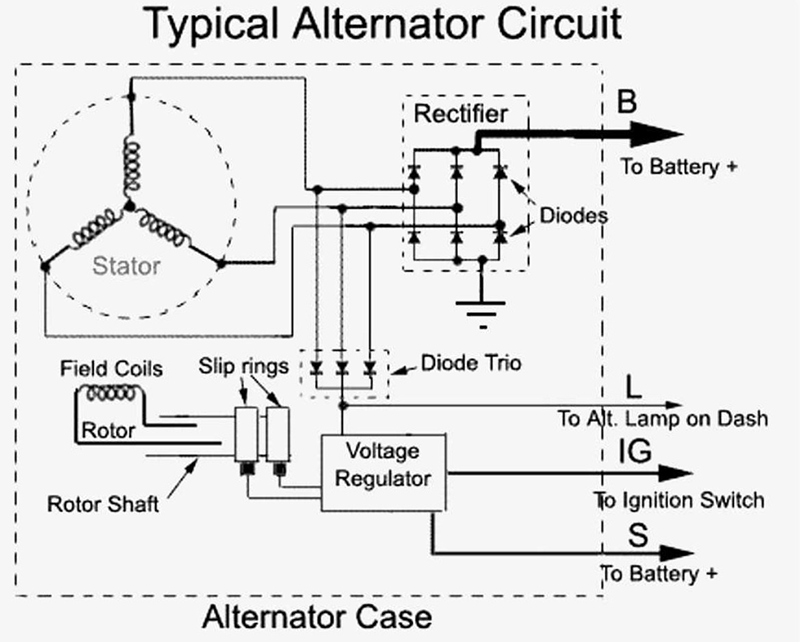
The alternator is based on the same electrodynamic principle as the generator. An electric current is induced in a wire as it passes through a magnetic field. It has some important differences, however. In an alternator, the magnetic field is created by windings on the rotor while the armature winding, called the stator, is stationary and fixed to the case surrounding the rotor. Connection to power the rotor windings from the battery are made by slip rings on the shaft which are in continuous contact with brushes. Thus, the magnetic field is rotating and the stator wires are stationary, producing the same electrodynamic effect.
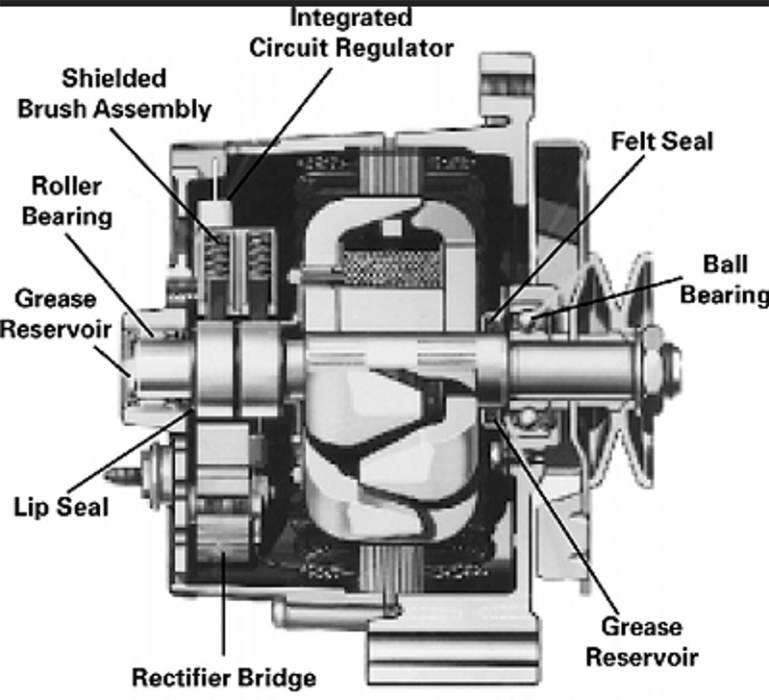
There are three separate stator windings arranged in what is referred to as a “Y” configuration. As a result, the alternator produces a three-phase alternating current with the phases 120 degrees apart. These AC currents are converted to DC by a diode bridge circuit. A diode is a circuit component which allows current to flow in one direction only. What made the alternator practical for automotive use was the development of semiconductor diodes simple and small enough to be integrated into the alternator case.
The advantage of an alternator over a dynamo-type generator is that the alternator can be regulated to produce an output current level nearly independent of engine speed. This is achieved by regulating the current from the battery to the rotor windings. The regulator consists of a solid-state circuit, usually built into the alternator case. It monitors the voltage level of the battery and adjusts the rotor current which produces the magnetic field so as to maintain the voltage between 13.5 and 14.5 volts, even at low engine speed.
Us old car folks have very likely had occasion to disassemble an old DC generator, view its internal parts, and make any needed repairs. Not so likely with an alternator. We wouldn’t be able to fix anything and, fortunately, due to its reliability, we won’t need to
Leave a Reply